Employee turning 65: a Medicare checklist for Texas employers
Help your employee turning 65 review Medicare and employer coverage: payer order, drug notices, HSA dates, family coverage and a neutral HR email.
7 min read By Dustin Neider
Key Takeaways
- Start with your plan documents, dates and benefits contact. Have the employee confirm personal Medicare sign-up requirements with Medicare or Social Security.
- For eligible job-based coverage cases, the Part B window ends eight months after work or group coverage ends, whichever happens first. COBRA does not extend it (https://www.medicare.gov/basics/get-started-with-medicare/sign-up/when-does-medicare-coverage-start).
- Covered people eligible for Medicare need a written drug-coverage notice each year before October 15. Other required times include joining the plan. CMS explains the notice duties (https://www.cms.gov/medicare/employers-plan-sponsors/creditable-coverage).
- The HSA contribution limit is zero from the first month of Medicare enrollment, including retroactive months. Use confirmed dates for payroll and tax review. IRS Publication 969 explains the rule (https://www.irs.gov/publications/p969).
- Before changing employer or union coverage or joining Medicare drug coverage, contact the benefits administrator. The change may affect the employee and dependents. Medicare explains why family coverage needs a check (https://www.medicare.gov/health-drug-plans/coordination/who-pays-first).
Your employee wants to keep working, and their 65th birthday is coming up. They ask what to do about the health plan. You can help them get answers without choosing Medicare coverage for them.
For an employee turning 65, start with your plan and their dates. Bring payroll and any covered family members into the discussion before making a change.
Use this guide to work through your plan questions and name who will answer them. For sign-up needs and dates, send the employee to Medicare or Social Security.
What should you check for an employee turning 65?
Start with your plan papers, key dates and a name to call. Keep this review apart from the employee's own sign-up choice.
These five questions give you a place to start:
- Which plan pays first when the employee has Medicare?
- When will work and the group health plan end, if they plan to leave?
- What does the current drug-plan notice say?
- Does payroll need to review Health Savings Account (HSA) deposits?
- What would a plan change mean for covered family members?
Give the employee your plan papers and a name to call. Have them confirm which parts of Medicare to join, and when, with Medicare or Social Security.
This guide helps you with your side of the plan review. It does not set first sign-up dates or decide who can delay Part B.
Who pays first: your plan or Medicare?

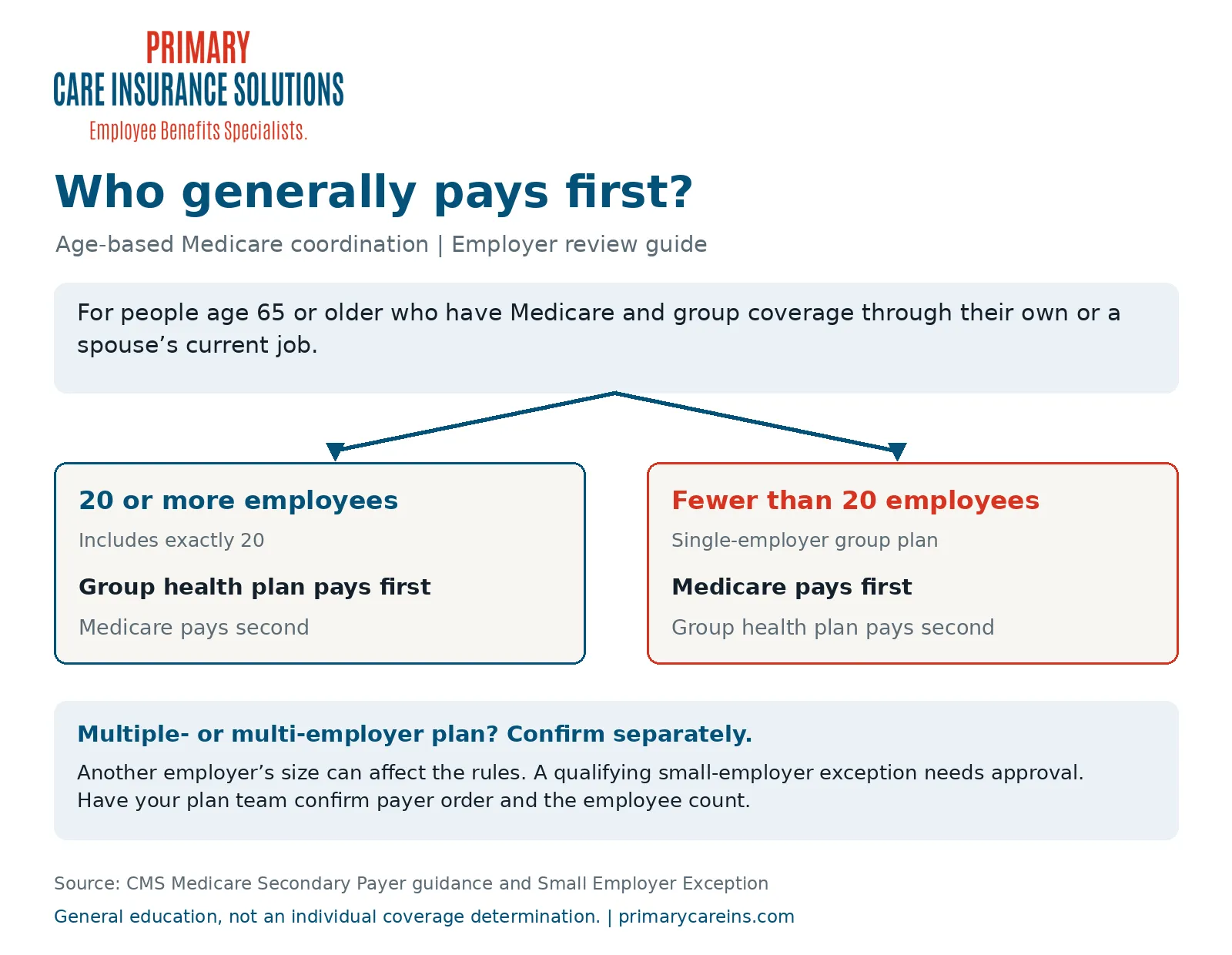
Employer size and plan type help set which plan pays first. These federal Medicare payer rules apply to people age 65 or older who have Medicare. They must also have group coverage through their own or a spouse's current job.
- With 20 or more employees, including exactly 20, the group health plan generally pays first. Medicare pays second.
- With fewer than 20 employees in a single-employer group plan, Medicare generally pays first. The group plan pays second.
- For a small employer in a multiple- or multi-employer plan, confirm the plan's rules separately.
In a plan with more than one employer, another employer's size can matter. If another employer has at least 20 employees, working-aged Medicare Secondary Payer rules may apply to the small employer.
These are rules for when Medicare pays second. A qualifying small-employer exception needs approval. Have the plan team confirm whether one applies.
Get the payer order in writing from your carrier or plan team. Include how they reached the employee count, plan type and any exception approval. Do not use the number of people on your health plan instead of that count.
Does COBRA extend the Part B sign-up window?
COBRA does not extend the Part B special enrollment window. This is the sign-up window for eligible job-based coverage cases.
COBRA lets eligible people keep group health benefits for a limited time. Medicare calls Part B medical insurance.
It ends eight months after work or group health plan coverage ends, whichever happens first. Medicare explains the Part B window and COBRA rule.
If the employee plans to leave, write down both end dates. Use the earlier date when they speak with Medicare or Social Security. Have them confirm whether this window applies and the plan start date they need.
Get the dates before you make a plan change. Give drug-plan timing its own place on your list of questions.
Is your drug coverage creditable, and what notice is due?
Creditable drug coverage is expected to pay, on average, as much as standard Medicare drug coverage. The federal Medicare agency defines creditable coverage and explains the notice rules.
Entities that provide drug coverage must give covered people eligible for Medicare a written notice of the plan's drug-coverage status. The annual notice is due before October 15. Other required times include when an eligible person joins the plan, under federal notice rules.
For your plan, get the current year's status from the carrier or plan sponsor. Agree on who will send the notice, then save it and the delivery record. Give the employee a copy to keep with their plan papers.
A gap may lead to a Part D late-enrollment penalty. Part D is Medicare drug coverage. A person may owe a penalty after 63 days or more without creditable drug coverage, when the relevant enrollment conditions apply.
Medicare explains those penalty conditions. Send personal drug-plan timing questions there. Keep that review separate from Part B; do not use its eight-month window as a drug-plan deadline.
How does Medicare affect HSA contributions?
The HSA contribution limit is zero from the first month of Medicare enrollment. This includes months the plan covers retroactively, or before the sign-up date. IRS Publication 969 explains the rule.
Part A is Medicare hospital insurance.
For premium-free Part A signup after age 65, coverage starts six months back from signup or an application for benefits. Those benefits are from Social Security or Railroad Retirement. Coverage cannot start before the month the person turned 65.
Medicare explains the Part A start dates. Those earlier months need a place in your payroll review. Use the actual dates, not a standard cutoff based on the birthday.
Work with the employee and their tax advisor on these steps:
- Confirm the Medicare start dates with Medicare or Social Security.
- Gather both employee and employer HSA deposits for the tax advisor.
- Get the advisor's instructions on eligible months and any needed corrections before changing payroll.
Your task is to help payroll act on the dates they confirm. Let the tax advisor work out the employee's limit and handle tax questions.
Could a change affect a spouse or dependents?
A plan change may affect the employee and their dependents. Before changing employer or union coverage or joining Medicare drug coverage, the employee should call the benefits administrator. Medicare advises this family-coverage check.
Get an answer for each person on the plan. Have your plan team spell out what would change, when, and what each person needs to do.
Save the plan team's answers before you process the request. Do not promise that family coverage will stay in place, or assume it will end. You need the answer for this plan and these family members.
How can you keep the conversation neutral?
Give plan facts without steering the employee out of your group plan. Where Medicare is secondary, employers must ensure their plans do not discriminate against employees and their spouses age 65 or older. This applies to those covered by Medicare Secondary Payer requirements.
Federal guidance states this employer responsibility. Keep your message focused on the plan facts and the employee's own choice. The email below gives you a starting point.
If you want to offer a payment, waiver or incentive tied to a plan change, take the idea to benefits and legal advisors. This guide does not assess those arrangements.
What should you document before a plan change?
Keep one file with an owner, the answer you need and a date to act. Use this checklist to track the work; it does not add legal notice duties.
- HR: save the plan papers and work and coverage dates. Give each open question an owner and a follow-up date.
- Carrier or plan team: confirm payer order in writing. Include the basis for the count, plan type and any exception approval.
- Employee: confirm personal sign-up needs and start dates with Medicare or Social Security. Bring open plan questions to your benefits contact.
- Plan sponsor or carrier: give the current drug-plan notice and name who sends it. Save the delivery record and confirm the notice dates.
- Payroll: gather both employee and employer HSA deposits. Save the tax advisor's instructions and the dates for action.
- Benefits administrator: explain what a change means for each covered family member. Save the answers and dates before the change.
- HR and benefits counsel: review your message and any proposed payment or waiver. Resolve open questions before you use it.
Finish each item with a next step. A name and a follow-up date give you more to work with than a note that says "Medicare question."
What should a neutral HR email include?
Invite the employee to talk about the plan and give them a benefits contact. Point them to help with their own Medicare questions. Keep the choice with the employee.
You can adapt this sample email to your plan; it is not a required legal notice.
Subject: Your benefits questions before age 65
Hi [employee name],
Please contact [benefits contact] to talk about your current health plan before you request a change. Bring questions about the drug plan and any covered family members.
Please confirm your own Medicare sign-up needs and dates with Medicare or Social Security. You can start with Medicare.gov.
If you have an HSA, go over your Medicare dates and deposits with your tax advisor. We can help you gather your employer-plan papers.
Bring any open plan questions to [benefits contact] before you request a plan or payroll change.
Thank you, [HR contact]
When should you bring your plan questions to PCI?
If an employee turning 65 leaves you with open employer-plan questions, bring those questions and your plan papers to PCI. Contact Primary Care Insurance Solutions to discuss the issues you need to take to your plan team.
Bring the written answers you have and a short list of what is still open. Keep personal Medicare choices with the employee and Medicare or Social Security. Take tax questions to a tax advisor and plan-specific legal questions to benefits counsel.
This guide is general education for Texas employers, not personal Medicare, legal or tax advice.
For your employee turning 65, name a benefits contact and gather the current plan papers. Use the checklist to get ready for the talk before you process a plan change.
Frequently Asked Questions
What should HR check for an employee turning 65?
Start with payer order, employment and coverage dates, the drug notice, HSA deposits and family coverage questions. Give each question an owner and a follow-up date. Have the employee confirm personal sign-up requirements and dates with Medicare or Social Security.
Who pays first when the employer has exactly 20 employees?
The group plan generally pays first with 20 or more employees, including exactly 20. This applies to people age 65 or older who have Medicare. They also need group coverage through their own or a spouse's current job. CMS explains these payer rules (https://www.cms.gov/medicare/coordination-benefits-recovery/overview/secondary-payer). Have your plan team confirm the employee count and any multiple- or multi-employer arrangement.
What changes when an employer has fewer than 20 employees?
Medicare generally pays first for a single-employer group plan with fewer than 20 employees. The group plan pays second. These rules apply to people age 65 or older who have Medicare. They also need group coverage through their own or a spouse's current job. CMS explains the small-employer payer order (https://www.cms.gov/medicare/coordination-benefits-recovery/overview/secondary-payer). In a multiple- or multi-employer plan, another employer with at least 20 employees can bring the small employer under different payer rules. A qualifying small-employer exception requires approval (https://www.cms.gov/medicare/coordination-benefits-recovery/employer-services/small-employer-exception). Have your plan team confirm the arrangement.
Does COBRA extend the Part B special enrollment window?
No, COBRA does not extend it. For eligible job-based coverage cases, it ends eight months after employment or group health coverage ends, whichever happens first. Medicare explains the window (https://www.medicare.gov/basics/get-started-with-medicare/sign-up/when-does-medicare-coverage-start). Have the employee confirm whether the window applies and the start date they need with Medicare or Social Security.
Why does Part A backdating matter for HSA deposits?
The HSA contribution limit is zero for Medicare-enrolled months, including retroactive months. IRS Publication 969 explains that limit (https://www.irs.gov/publications/p969). For premium-free Part A signup after age 65, coverage starts six months back from signup or applying for benefits. Those benefits are from Social Security or Railroad Retirement. Coverage cannot start before the month the person turned 65. Medicare explains the Part A dates (https://www.medicare.gov/basics/get-started-with-medicare/sign-up/when-does-medicare-coverage-start). Have payroll and the employee's tax advisor review both employee and employer deposits against the confirmed dates.